

Apocalypse Now? Maybe not.
HBO’s darkly amazing new series, True Detective, co-stars Matthew McConaughey, Woody Harrelson and south Louisiana. I use that particular billing because the surreal landscape is such a strong character it’s difficult to imagine its denizens being anywhere else. The third episode had the guys driving through an embattled terrain more wet than dry, and talking about how the land there is fast disappearing. Having lived in New Orleans, I knew this was no plot gimmick. Thanks to logging, drilling, oil spills, dredging and other man-made nightmares, the Gulf of Mexico gobbles up a football field of Louisiana wetland every hour. Every hour! No, that’s not a typo.

Louisiana’s fabled cypress swamps were once as lush as they were hauntingly beautiful.
When the French arrived in 1699, appropriately enough on Mardi Gras day, they christened the new colony La Louisiane to honor King Louis XIV. It quickly acquired more realistic names, notably the “wet grave” and flottant, or “floating land.” Today’s Bourbon Street tourists don’t know that just a few miles away the Gulf is devouring the Louisiana coastline like some blind, ravenous monster headed straight for the French Quarter. I learned the ugly truth back in the ‘90s when I drove down to see for myself. That steamy summer afternoon is forever burnished in my memory’s chamber of horrors.
The way to the water is Highway 23 through Plaquemine Parish, a ragged sliver thrust deep into the Gulf and containing–just barely–the mouth of the Mississippi and the river’s last seventy miles. A couple of historic forts and some orange groves provided bursts of beauty and color, as did clouds towering to infinity and an otherworldly shoreline sculpted by wind and water. Otherwise it was a relentlessly flat landscape pocked with sagging shanties, rusty, dilapidated trailers and helicopter landing pads for ferrying workers to thousands of offshore oil rigs. The further south I went, the poorer things got (I later learned almost one in five parish residents live below the poverty line), and the grand finale was Venice, the southernmost Louisiana town accessible by car. With an elevation of three feet, it’s nicknamed “end of the world,” and if you saw it, you’d be a believer. Mother Nature rules here and, like a carnival reveler, she’s always waiting to strut her stuff. That ain’t necessarily a good thing.
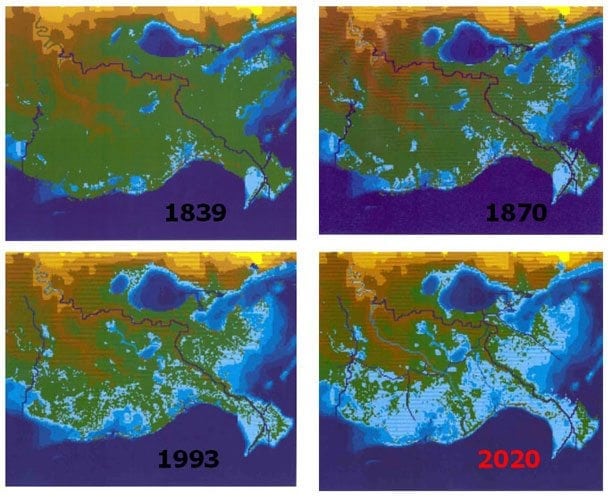
These four maps say it all.
I backtracked to an unnamed road to nowhere, and pretty soon the earth was playing hide-and-seek with the water. Or maybe it was the other way around. Terra firma lost the game when water began lapping from both sides of the road, and I knew it was time to turn around when my tires left a lazy wake. I killed the engine and got out, shading my eyes from the notorious delta sun. Here and there were the remnants of great stands of cypress, strangled to death by saline intrusion and bleached white like the bones of some great primeval beast. These ghostly forests were their own tombstones, channel markers for how far the salty ocean had invaded the freshwater marsh. I’d never seen anything more haunting or apocalyptic.

What happens when man messes with nature.
Happily, forces are at work to reclaim Louisiana’s beleaguered wetlands and keep the sea at bay. Old Christmas trees, of all things, are providing successful anchors for vegetation, as are massive chunks of concrete. A much more ambitious project is a new channel to redirect the Mississippi into the Gulf, silting up the present mouth of the river and spawning new protective wetlands. There’s other good news. Despite Katrina’s efforts to erase them, Venice’s world-class deep-sea fishing and Plaquemine’s citrus groves have made remarkable comebacks. Now, with Woody and Matthew pumping money and jobs into the struggling stretch of sand and sea that is south Louisiana, it looks like the Four Horsemen may have to wait awhile.

I am mesmerized by everything about True Detective and so I deeply appreciate your giving this background information on the locale. It seems so other-worldly to me, the perfect setting for the bizarre, multi-layered story/stories being told by this excellent series. Thanks, Michael!
Amazing post. Thank you, Michael.
I haven’t seen ep 3 yet. Mixed feelings about the series, being very drawn to Matthew’s character and not very intrigued by Woody’s. The series does have a surreal feel.
Beautifully written and evocative. I have known about the loss of Louisiana land for a while but your comment brought it home most clearly.
Have to tell you a McGovern campaign story. You probably know I managed the Louisiana fight for delegates. I had a number of great college kids who were willing to go anywhere, but I forbid them to go to Plaquemine. One day a kid didn’t show up for a meeting. When he came back the next day he told me he couldn’t stand to have the people there not know about George McGovern,so he went down there. “They were very nice,” he said. I’m still glad he made it back.
For countless thousands of years, sediment carried by the Mississippi River sustained the delta and wetlands of coastal Louisiana. Today, levees and other man-made structures have brought these processes to a virtual halt.
Reintroducing freshwater and sediment to the coastal system and restoring natural water flows is critical to reconnecting the Mississippi River to its delta.
Whether through diversions like mid-Barataria and White Ditch, non-structural flood protection, barrier island restoration, oyster reef restoration or beneficial use of sediment dredged from the mouth of the Mississippi River, restoring the delta will take much more than just moving dirt and planting marsh grasses.
In order for nature to reassert herself, it will necessitate people leaving the comfort of their homes. People living in the area are the problem.
This is all news to me. Thanks Michael for enlightening me once again. I love these blogs!
You’re welcome, Karen. Thanks for your interest.