

Character Study
Reviews and reader responses are always a surprise, and my book Communion of Sinners is no exception. I hadn’t expected so many requests to see my protagonist Sam Crockett in another book, nor so many people expressing admiration for Manuel Alvarado, my Chumash Indian artist. Based on a couple of New Orleans friends, Sam was a breeze to create, but Manuel was a challenge who emerged for a couple of reasons. Once I began writing about the enslavement of the Indians under the California Mission system, I worried about my story being too dark and negative and knew I needed a character the reader could sympathize with and root for. That’s when Manuel began tugging at my mental sleeve, but knowing I needed him and knowing something about him were two different things.
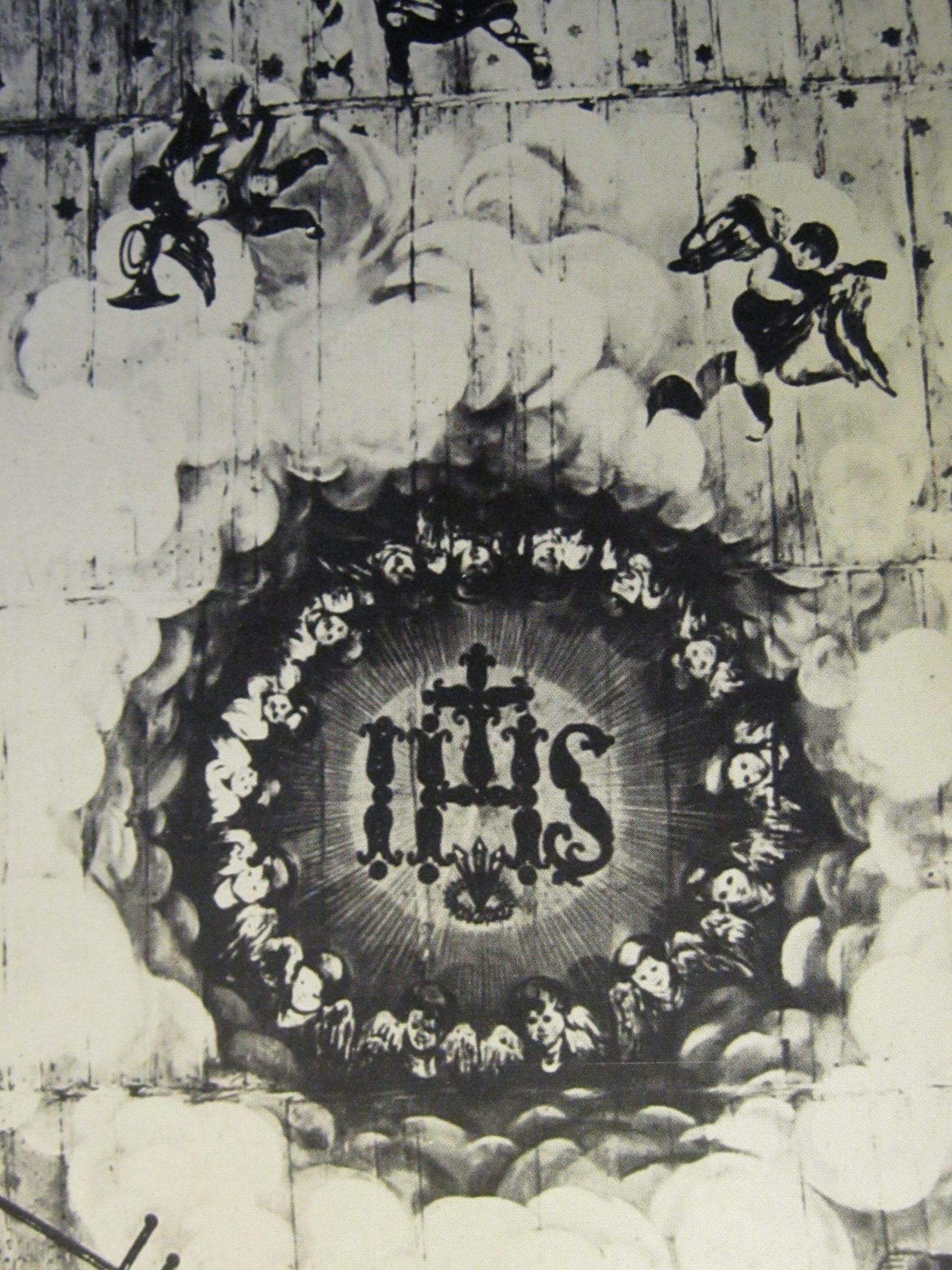
Even in black and white, Indian artwork in the California Missions remains strikingly sophisticated.
I noodled several approaches, thinking Manuel could be a hunter, a farmer or maybe even a shaman, but none seemed to work. A photograph, historic fact or quote can often inspire characters, and my dilemma was resolved when I saw an illustration of the ruins of Mission Santa Cruz. What caught my eye was not so much the derelict building as the painted designs decorating the beams. I wondered who managed to create beauty in such an oppressive environment. Research revealed that the ornamentation came not only from Spanish artists but from Indians with a natural flair for painting, and, voila, Manuel Alvarado was born. The reader would see the Indian world through an artist’s eye, enabling me to paint verbal pictures of a time and place long gone. When I learned how Manuel would have gathered plants and minerals for creating paint colors, for example, the result was this scene.
“Manuel’s spirits soared as he followed his mother and her friend Mariana through the mission gate and down the hill alongside fields of corn, barley and grain. Beyond stretched land where he could find hematite for red, gypsum for white and, if he was lucky that day, wolf lichen yielding a rich yellow sure to please the padre.”
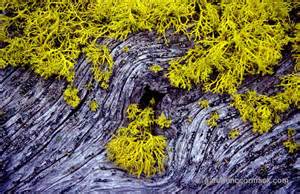
Wolf lichen provided rich yellow dyes for adorning chapel walls and beams.
Unfortunately the beauty of that morning is vanquished by the violence that follows and by the terrible moment when Manuel is ordered by the padre to carve the most hideous wooden doll he can imagine.
“The padre nodded at the grotesque effigy on Manuel’s workbench, visibly repulsed by the maw of a mouth, gouged-out eyes and twisted limbs. Even half-painted it was horrifying.”
Why Manuel is forced to turn his God-given talents into creating such a monstrosity will be discovered by the reader, but suffice it to say there is a direct connection to the baptismal font at Mission Santa Cruz. When I saw it for myself and rested my hand on that worn, pocked stone, a shudder shot through me that I’ve never forgotten. I recreated that revelatory moment for Sam Crockett.
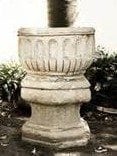
Countless Indian infants were baptized at the font at Santa Cruz Mission.
“The Mission’s original baptismal font. Can you imagine? Hundreds of doomed Indian babies were splattered by this thing, probably Manuel Alvarado.” Sam caressed the worn bowl. “I can’t help thinking about that poor little guy and how mission life devastated his family.”
As Manuel’s life journey draws to an end, he revisits Santa Cruz Mission that had been the source of so much misery for him and his people. By then, the entire mission system had imploded, the buildings were abandoned, and the ill-fated Indians they imprisoned were scattered to fend for themselves, thus bringing things full circle. When I wrote this scene, I was remembering the moment I first saw that drawing of the collapsed chapel and conceived the character of Manuel Alvarado. I knew it would inspire love and hate in his soul.
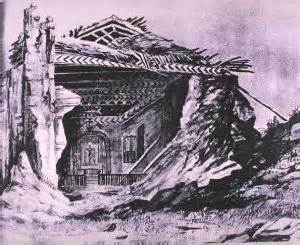
“Manuel discovered the old chapel had caved in, exposing his carved beams and painted pillars to the sky. Like the mission system itself, it was consumed from within, and yet his heart was stirred for this was where he had come into the world, a place he adorned with works designed to glorify God.”
Sam and Manuel are both good men struggling to do the right thing while confronting destinies dictating otherwise. How their lives become directly intertwined, despite being separated by centuries, was my greatest challenge and provides one of the biggest reveals in the book. If you haven’t already read about them, perhaps this character study will tempt you to do so.

It’s always interesting for readers to learn how writers are inspired to create their characters. Especially ones that are out of the ordinary or beyond the realm of the writer’s experiences. Of course, that’s why writers are writers — they can more easily go beyond their own experiences. Or expand on their own experiences and produce vivid individuals who walk off the page, just as Manuel does in your terrific book.
Thanks, as always, for these insights.