

Doomed or Damned?
When I began researching the California Missions for my first mystery, Communion of Sinners, I discovered the system was problematic from the earliest days. The often inhumane treatment of the Indians by the Franciscan padres and Spanish soldiers (the subject of two previous blogs), made me wonder how much wretchedness the Missions brought on themselves. The question of karma arose when I learned how much Mother Nature heaped atop the man-made misery. The very first Mission, San Diego del Alcalá, founded on its present site in 1794, was around barely fifteen months when the Indians avenged their people’s abuse. Some six hundred warriors attacked the compound and burned it to the ground in a blaze intense enough to melt the communion chalice. Father Luis Jayme was killed, earning him the dubious honor of being California’s first martyr. He was only the first of many priests whose unwelcome efforts to Christianize the local populace led to their own destruction.
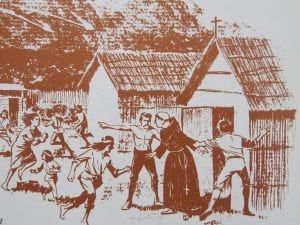
Mission San Diego got torched by the Indians early on.
Mission San Juan Capistrano experienced different dilemmas. It was struggling with a string of terrible storms and floods destroying crops crucial to survival when a 7.0 earthquake slammed the region in 1812. Was it merely an unlucky coincidence that it struck on the Feast Day of the Immaculate Conception when the church was packed? The quake wrenched the doors shut, trapping forty Indians inside, and more tremors brought the 50-foot-high ceiling crashing down, killing everyone. Two hapless Indian boys ringing the church bells were also crushed to death when the 120-foot bell tower collapsed. Where were the padres that they escaped unscathed?
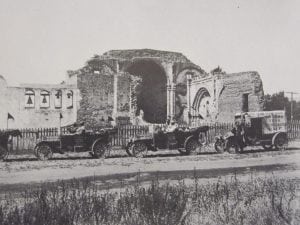
A massive earthquake collapsed the church at Mission San Juan Capistrano, killing 42 Indians.
Nicknamed the “Lonely Mission,” Soledad was founded in 1791 on a sunbaked, wind-blasted plain uninhabitable without irrigation. Little wonder that the area was called the Devil’s Frontier or that the poor, beleaguered padres fought an uphill battle for water and survival. The place was so impoverished and remote that priests actually prayed not to be assigned there. The brutality of Soledad priest Diego Garcia is well documented, but little is known about a triple murder in 1802. The last priest, Father Vincente Francisco de Sarria, collapsed from starvation and died on the altar in 1835, right after saying Mass.
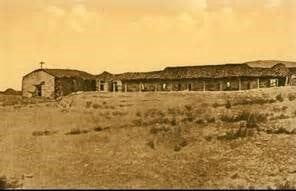
Desolate, remote and desperately poor, Soledad was called “The Lonely Mission.”
For sheer damnation, however, none could compare to Mission Santa Cruz. Nicknamed the “Hard Luck Mission,” its unending sob stories included not just the requisite fires, famines, floods and earthquakes but plague, crime, kidnapping and even a pirate! Spanish law forbade the settlement of pueblos within a league of the Missions, but Governor Borica nonetheless ordered the founding of Branciforte, which quickly became a haven for smugglers, gamblers, prostitutes and other assorted miscreants. Enormous friction arose when the townspeople took over the padres’ valuable pasturage and bullied the already unhappy Mission Indians. In 1806, the area suffered the most disastrous epidemic in California’s Spanish Era when so many thousands of Indians died of measles their population was reduced by one fourth! More bad news arrived in 1818 when Argentine pirate Hippolyte Bouchard was spotted off the coast of Monterrey. Known for pillaging the Missions and coastal communities, his presence prompted the padres to round up their flock and flee inland after extracting a promise that Branciforte would protect the Mission. When the pirate decided not to put ashore, the townspeople looted the entire compound themselves, stealing wine, food, farm implements. Even the church candlesticks and saints’ vestments disappeared.
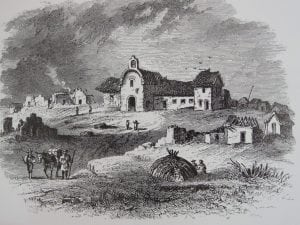
Santa Cruz trumped all other Missions in the catastrophe sweepstakes.
When runaways and disease depleted Santa Cruz’s Indian population, the priests dispatched raiding parties to inland villages to kidnap more “converts.” The worst of the padres, Andrés Quintana had a fondness for metal-tipped whips, and when he turned his attention to children, the Indians sent a message by not merely killing the sadistic priest but emasculating him as well. (Ignoring the fact that Quintana was California’s first autopsy–and a nasty one at that– most tourist brochures report that Quintana “died peacefully in his sleep.”) The end of Santa Cruz and the rest of the Missions came in 1833 when Mexican Governor Jose Figueroa announced secularization. The padres left, Mission lands were confiscated and sold for private, usually unsavory profits, and the poor Indians turned out and left to starve. The abandoned buildings quickly fell prey to scavengers who stripped away roof tiles and tore apart walls for the adobe bricks. The death knell for Santa Cruz Mission finally sounded in 1840 when an earthquake toppled the bell tower. A second quake in 1857 shattered the church façade and leveled what remained of the outbuildings. The compound quickly turned to adobe dust and rotten timbers. A half-size replica built in 1931 barely hints at the place’s turbulent history.
Whether this particular mission was the victim of hard luck, bad karma or a combination of the two, its picaresque characters and self-destructive saga proved irresistible. When I scouted settings for Communion of Sinners, Santa Cruz Mission won hands-down. Available from Scaramouche Publishing.

Michael, as I read this piece, what popped into my head was the amazing and shocking white-washing that has taken place, the revision of history that has occurred thanks to the power of the Church. I suggest you send Pope Francis a copy of your book as soon as it is published.
Thanks, again, for a powerful, thought-provoking essay.
Liz
I am continually impressed with the scope and breadth of your research. Communion of Sinners promises to be one of your best works yet. There is certainly no shortage when it comes to a great cast of characters. It’s no wonder the current Pope necessarily appeals to the masses, again. It’s a matter of survival.
Having grown up within a single block of the Carmel Mission, your research blows me away! Trust me, even as a non-Catholic, we were never taught this history in our California Social Studies classes! Can’t wait for the book to be published…and I’m sure you’re prepared to raise a few hackles. As they say in the journalism business “Truth is [still] a defense.” Bravo!