

Invasion of the Body Snatchers
Researching Venice for my next time travel book exposed some peculiar surprises about my favorite Italian city. Tourist hordes, floods and exorbitant prices aside, it endures as a spectacular living museum, but some due diligence revealed that, like its patron St. Mark, some of Venice’s more famous artworks didn’t arrive willingly.
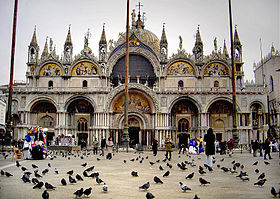
Napoleon called the Piazza San Marco “Europe’s drawing room.”
Like most empire-builders, the Venetians were notoriously light-fingered. In 828, with its archrival Rome boasting St. Peter’s tomb, Venice decided its patron saint, Theodore of Amasea, didn’t carry enough clout. Seeking someone more prestigious, and with the remains of Jesus’s disciples being a limited commodity, they went after Mark’s relics in Alexandria. Thieves masquerading as merchants sailed for Egypt, snatched the body and stashed it under a layer of pork to discourage inspection by Muslim port authorities who considered swine untouchable. Mission accomplished, the Venetians took their sacred albeit grisly trophy home, ditched poor Ted, elected Mark in his stead and built a church to house those pilfered bones. Rome was appalled by the grave robbing, but Venice’s newly acquired status could not be denied. St. Mark’s Basilica became the city’s most celebrated landmark, and his symbol, the winged lion, represents it as well.
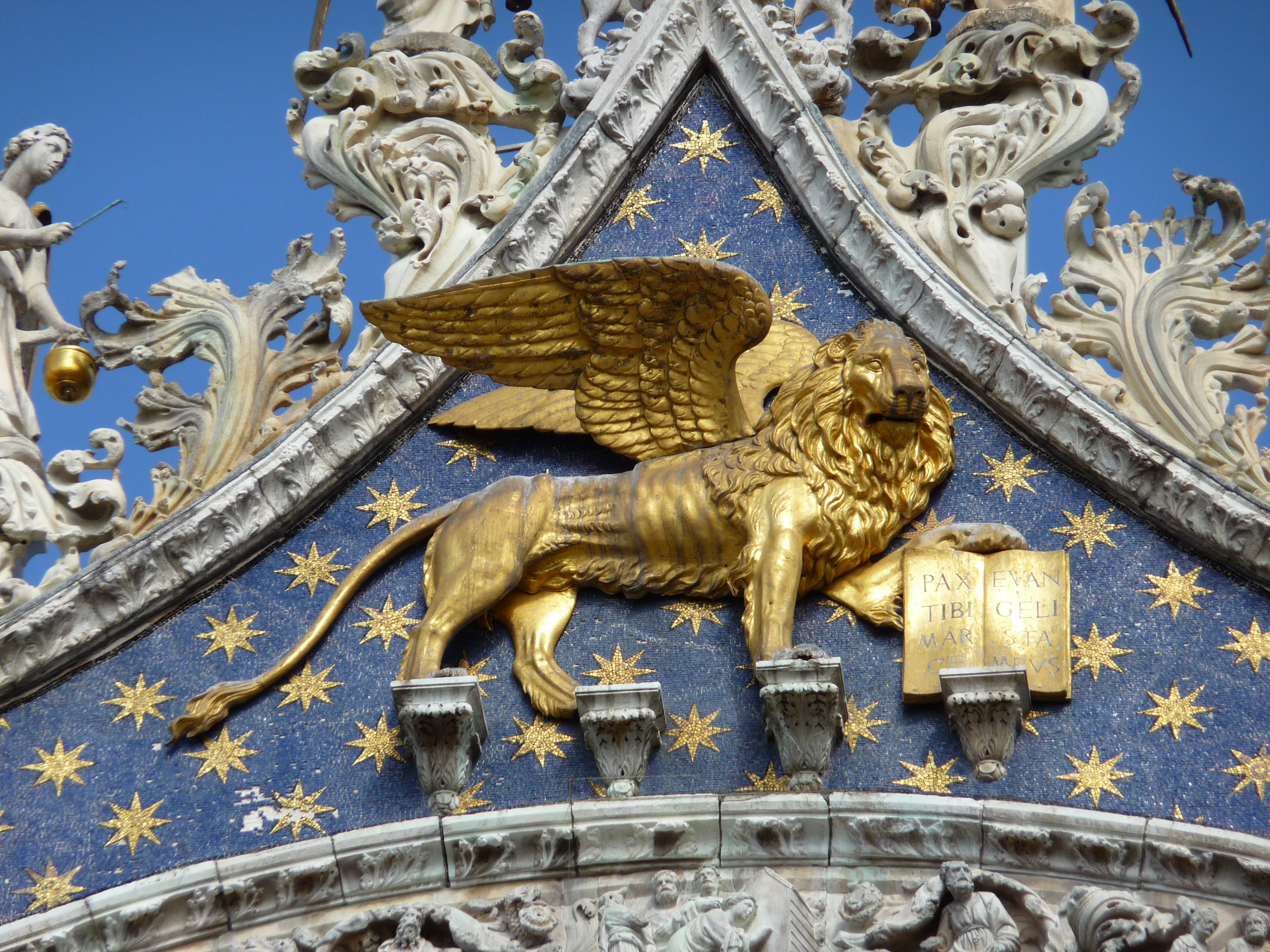
Venice teems with winged lions, none more glamorous than this.
One of the city’s most famous and oft-photographed artworks was also pillaged. Perched on a corner of the Basilica where it joins the Doge’s Palace, the porphyry statue of the Four Tetrarchs (Roman emperors) was taken when Venice sacked Constantinople during the Fourth Crusade in 1204. The theft wasn’t a total success since one of the statues was missing a foot. Turkish archaeologists were stunned in 1965 when they unearthed it during a routine dig, but when Venice asked to reunite it with the leg, they got a chilly reply: “You stole the statue. We’re keeping our foot.” It remains in the Istanbul Archaeology Museum.
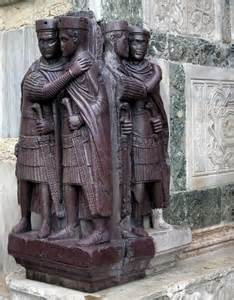
One of Venice’s iconic tetrarchs is missing a foot.
An even more flamboyant theft involved my favorite Venetian icon, the quartet of copper horses perched atop the Basilica’s loggia. These majestic metal creatures, so energetic they seem eager to prance into the piazza, were created in Greece in the 4th Century B.C.E. only to be seized by Byzantine emperors to grace Constantinople’s grandiose Hippodrome. Deciding that one good theft deserved another, the Venetians grabbed them, and, unfortunately, severed the horses’ heads (shades of The Godfather!) to facilitate transporting them home by sea. Collars were added to mask the dirty deed, but other problems arose when warmongering Venetian admirals wanted to melt the metal statues for cannon. Saner heads hid them away to avoid further temptation, and half a century later, during peacetime, the horses were finally ensconced on the Basilica. The Venetians would learn, however, that the spoils of war could be lost as easily as they were gained.
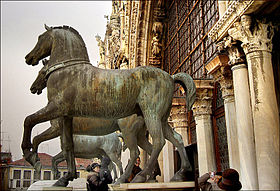
Venice’s famous horses are anything but Venetian.
When Napoleon conquered Venice in 1797, he cast a covetous eye on the horses and carted them off to Paris to decorate the Arc de Triomphe. There they remained until his defeat at Waterloo, after which the Emperor of Austria ordered them returned to Venice, but the journey still wasn’t over for these peripatetic beasts. In the 1980s, air pollution from the nearby industrial port of Marghera began devouring Venice’s priceless outdoor treasures, prompting the removal of the horses to a museum inside the Basilica. Gorgeous though they may be, what we see looming over the Piazza San Marco today are fabulous fakes.
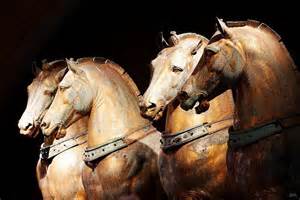
These days, the original Greek steeds are safely stabled away.
When the Adriatic’s ever-rising acqua alta sends Venice to her watery grave, as it inevitably will, I can only wonder where these restless horses will go next.
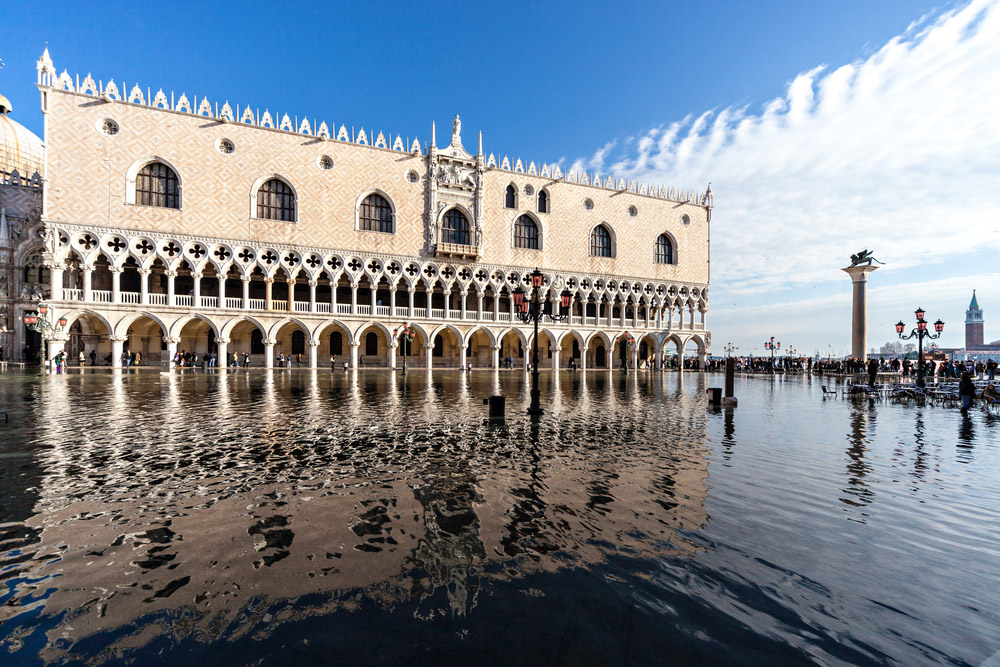
The Adriatic rises higher ever year, raising the eternal question, “Can Venice be saved?”
Really interesting, Michael, as always. I’m learning a lot from your blog entries. Keep ’em comin’.
This history blog was so interesting. I really enjoy my history lessons from you Michael . I would have paid attention to World History, if you had been teaching it.
Another fabulous piece, Michael. And such wonderful photos, as well. We are so lucky to have you unearthing these amazing tidbits and sharing them so generously. Please don’t stop!!
Dan Brown’s, Inferno, explored much of Venice and delved into the details of Dante’s Inferno. There is also that odd sculpture of Hercules and Diomedes that catches many tourists off guard. Thanks for posting. There are treasures galore for anyone who dares to look. Is it not true that tourism is now the greatest national product of Italy? I look forward to your next installment, Michael!